Stop Blaming Cortisol for Your Weight Gain
Stop Blaming Cortisol for Your Weight Gain
Before you blame your hormones, let's talk about your habits.
Cortisol has become quite the celebrity in the weight-loss world.
It's apparently responsible for your belly fat, your cravings, your fatigue, your stubborn scale, and possibly the fact that your jeans fit differently than they did in 2012.
And if you spend enough time on social media, you'll discover that someone has a supplement, a special diet, or a morning routine guaranteed to fix it.
How convenient.
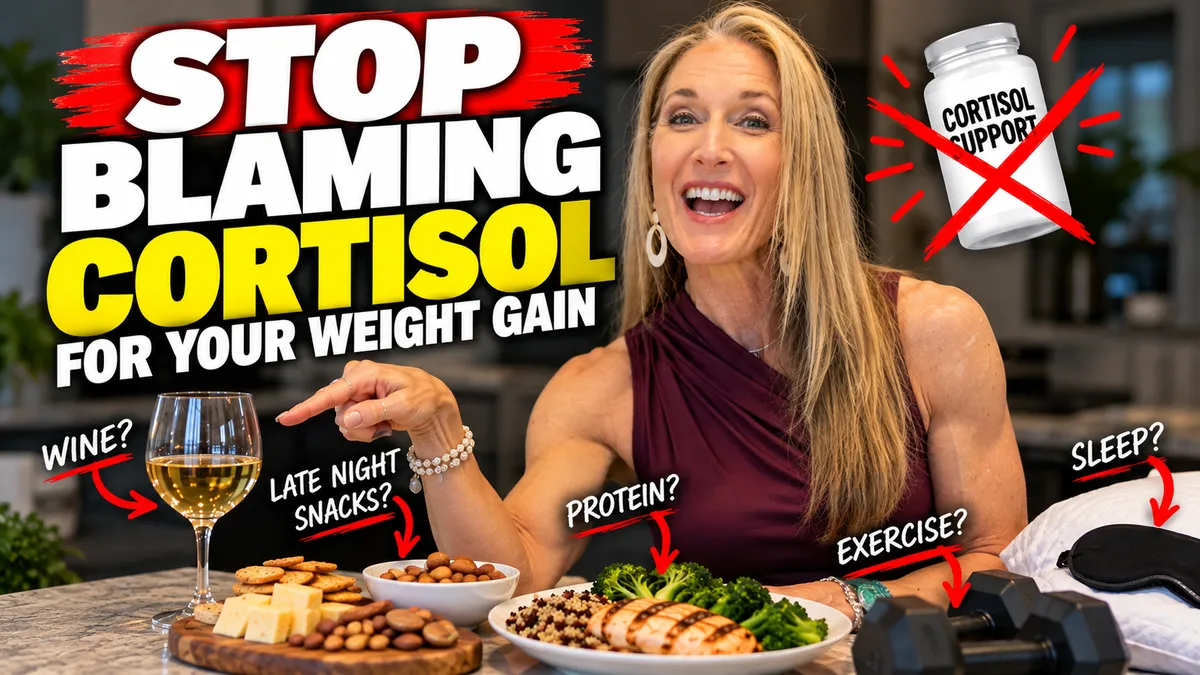
Meanwhile, you might be drinking two glasses of wine most evenings, getting six hours of sleep, missing your protein goals, and exercising whenever the stars align.
But sure. Let's investigate your cortisol.
I'm not dismissing hormones. I'm questioning why we've become so eager to investigate them before examining the habits staring us in the face.
After more than 30 years of coaching nutrition, fitness, and weight management, I've learned something: The most interesting explanation isn't always the most useful one.
And when it comes to weight loss after 40, we've developed a remarkable talent for making things more complicated than they need to be.
Your Cortisol Is Not a Criminal
First, a little physiology.
Cortisol is a hormone produced by your adrenal glands. It helps regulate blood glucose, blood pressure, metabolism, and your body's response to stress. It also follows a natural daily rhythm.
You need cortisol. Having cortisol is not a diagnosis.
Chronic stress can influence appetite, sleep, and eating behavior. Menopause can affect body composition and where fat is stored. And certain medical conditions, including Cushing syndrome, can cause excessive cortisol production and weight gain.
Those are legitimate medical considerations.
But here's where the conversation goes sideways.
Having belly fat does not prove you have high cortisol. Neither does feeling tired, craving chocolate, or struggling to lose five pounds.
Those experiences have multiple possible explanations. They are not a hormone panel.
If you have symptoms suggesting an endocrine disorder, your healthcare professional can determine whether appropriate testing is warranted.
But for most women frustrated with their weight, there's a much more productive place to begin.
And it probably doesn't involve ordering a $50 bottle of adrenal support capsules.
The Wine Isn't Invisible Just Because It's in a Pretty Glass
Let's have the conversation nobody particularly enjoys.
Alcohol.
I routinely hear concerns about hormones, inflammation, metabolism, and cortisol from women who haven't seriously examined their alcohol consumption.
A couple glasses of wine after dinner? No big deal, right?
Well, it depends on your goals, your portions, and how often those glasses appear.
Two generous pours can contribute several hundred calories. Repeat that most evenings and you've added a meaningful amount of energy to your week.
And that's before the cheese, crackers, handful of nuts, or whatever else looks particularly appealing after glass number two.
Alcohol can also interfere with sleep quality, which may leave you tired, hungrier, and less enthusiastic about moving the next day.
I'm not saying you can't enjoy wine and lose weight. I'm saying wine doesn't become metabolically irrelevant because you consider it self-care.
You don't need a lecture about alcohol.
You need an accurate accounting of its place in your routine.
Before you spend money investigating why your body isn't responding the way you'd like, consider whether something you're doing regularly is making that outcome harder to achieve.
That's not blame. That's useful information.
You Know Your Cortisol Theory. Do You Know Your Protein Intake?
Here's another fascinating pattern.
Ask someone what she thinks is happening with her hormones, and she may have a remarkably detailed explanation.
Ask how much protein she eats each day?
"Well, I eat pretty healthy."
Wonderful. But that's not a number.
And if your goal is to lose body fat while maintaining muscle, particularly during midlife, protein deserves considerably more attention than it's getting.
Adequate protein supports muscle maintenance, recovery, and satiety. Paired with consistent resistance training, it helps protect the muscle you're working to preserve while losing weight.
It doesn't magically override calorie balance, and more isn't automatically better. Your appropriate intake depends on your body size, health, activity, and goals.
But if you're routinely falling short, we have something practical to work on.
Improve breakfast. Build a more substantial lunch. Include a meaningful protein source at dinner.
No exotic ingredients. No hormonal treasure hunt.
You can't supplement your way around the fundamentals.
And those fundamentals become increasingly important when maintaining strength and muscle is part of the goal.
Menopause Changed the Conditions. It Didn't Cancel the Rules.
Let's be clear: menopause is not imaginary, and neither are the changes many women experience.
Shifting estrogen levels can influence fat distribution. Changes in sleep, activity, muscle mass, and overall energy expenditure can make weight management more challenging.
The body you have at 55 may respond differently than the one you had at 30.
I don't dispute that for a second.
What I dispute is the leap from "My body has changed" to "My body no longer responds to anything I do."
That's a very expensive belief to adopt.
It can send you searching for specialized hormone diets, metabolism boosters, and cortisol protocols while overlooking the fact that your current routine may no longer match your current needs.
Your strategy may need updating.
Perhaps you need a more realistic calorie target, greater attention to protein, consistent resistance training, or more movement throughout the day.
Perhaps menopausal symptoms are disrupting your sleep enough that medical treatment deserves consideration.
All of those possibilities are worth examining.
But menopause doesn't eliminate the relevance of energy balance, and cortisol doesn't get to take the blame for every frustrating weigh-in.
Your body may have changed. Your willingness to work with it shouldn't disappear.
Stress Matters. But Not Always in the Way You Think.
I can practically hear the objection.
"But my life really IS stressful!"
I believe you.
And stress deserves attention.
But let's examine what it's actually doing to your day.
Are you skipping lunch because you're overwhelmed, then arriving home ready to eat everything that isn't nailed down?
Are you sleeping poorly?
Have your workouts disappeared from the calendar?
Are you relying on alcohol to decompress?
Are you choosing convenience foods more frequently because you're exhausted and have no plan?
These are common ways stress can interfere with weight management.
Cortisol and other physiological responses may play a role, too. But focusing exclusively on the hormone can distract from changes that might actually help.
Sometimes stress management means establishing boundaries, getting professional support, improving sleep opportunities, or making your nutrition plan less demanding.
Sometimes it means preparing tomorrow's lunch before tomorrow becomes a circus.
Stress may explain why your habits have become harder to maintain. It doesn't make those habits irrelevant.
And the solution isn't always to try harder.
Often, it's to make the plan easier to execute.
The Cortisol Distraction
I call this the Cortisol Distraction.
It's what happens when searching for a sophisticated biological explanation becomes more appealing than addressing the ordinary behaviors that influence your results.
And cortisol is hardly the only candidate.
We've blamed insulin, inflammation, metabolism, age, and practically every hormone that can be pronounced on a podcast.
Some of those factors absolutely warrant attention.
But a scientific-sounding explanation isn't automatically the correct one.
And a hormone isn't automatically the primary reason your weight has stalled.
Sometimes your calorie intake is higher than you realize.
Sometimes your activity has declined.
Sometimes your weekends are undoing the calorie deficit you've created during the week.
Sometimes you need more time and better progress measurements.
Sometimes a medical condition or medication deserves investigation.
And sometimes several things are contributing at once.
That's why effective weight management requires curiosity, accuracy, and a willingness to examine the evidence.
The goal isn't to find the most complicated explanation. It's to find the most useful one.
Before You Blame Cortisol, Answer These Questions
I want you to consider five things:
Alcohol: How much are you actually drinking each week, and what happens to your eating and sleep when you do?
Protein: Are you consistently meeting an appropriate protein target, or are you estimating based on how healthy your meals look?
Movement: Are you strength training regularly and staying reasonably active outside the gym?
Sleep: Are you giving yourself enough opportunity for restorative sleep, and are untreated symptoms interfering with it?
Energy intake: Do you have reliable evidence that your overall food intake supports your fat-loss goal?
These aren't accusations. They're starting points.
And you don't need to fix all five by Monday.
Choose the area where there's an obvious gap. Make one meaningful adjustment. Practice it consistently and evaluate what happens.
If symptoms or lack of progress suggest something beyond your habits, investigate that appropriately with your healthcare professional.
But don't skip the fundamentals simply because they're less exciting than the latest hormone theory.
Sometimes the Answer Is Sitting in Your Kitchen
I understand the appeal of blaming cortisol.
A hormone feels mysterious. A supplement feels promising. A complicated explanation can be reassuring because it suggests there's a hidden answer waiting to be discovered.
And sometimes there is a medical issue that needs treatment.
But sometimes the most useful discovery is that your nightly wine, inconsistent meals, inadequate protein, poor sleep, or lack of resistance training deserves more attention.
That doesn't mean you're doing everything wrong.
It means you have opportunities to make things better.
And that's encouraging, because these are areas where you can often make meaningful changes without waiting for a new product, a perfect hormone panel, or another Monday morning.
Before you ask what your hormones are doing to your weight, ask what your habits are doing for your health.
You don't have to choose between respecting your physiology and taking responsibility for your behaviors.
You can do both.
And that is a much better weight-loss strategy than assigning cortisol a starring role in a story where it may not even be the main character.
Ready to Stop Guessing?
At Wright-Sized Wellness, I help women move beyond weight-loss noise and build practical nutrition, strength, and lifestyle strategies that fit their current stage of life.
No magic hormone hacks. No unnecessary extremes. Just experienced, evidence-informed coaching that turns useful information into consistent action.
For personalized coaching, contact [email protected].
Do good. Have fun. Be well.
Resources I Know You’ll Love
Tired of feeling unsure of where to find quality supplements?
Many women navigating midlife health concerns—whether it’s energy, metabolism, bone health, or hormonal support—want to use supplements wisely but feel overwhelmed by the options available online.
That’s why I recommend Fullscript, a professional supplement dispensary that gives you access to high-quality, practitioner-grade products from brands that prioritize testing, purity, and transparency.
Instead of guessing which supplements are legitimate, Fullscript allows you to shop from vetted brands in one place, with clear information about ingredients and quality standards.
👉You can explore my Fullscript dispensary here - and don't hesitate to reach out to me at [email protected] if you need additional guidance.