Losing Weight on a GLP-1 Is One Thing. Keeping It Off Is Another.
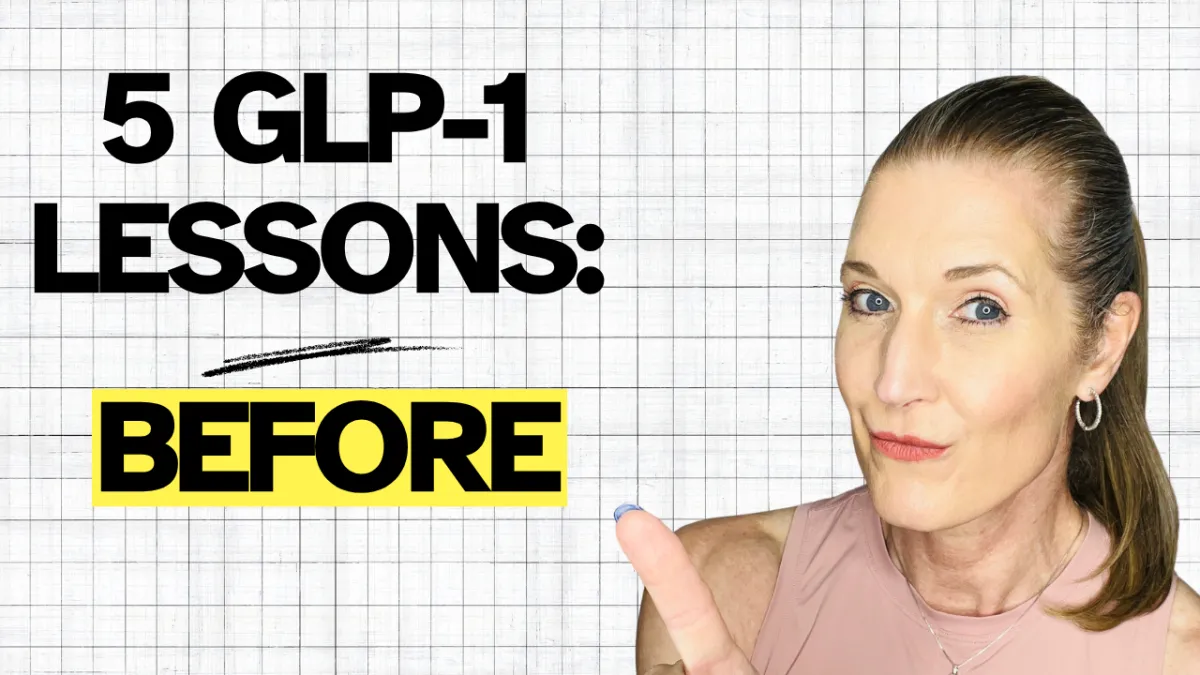
Losing Weight on a GLP-1 Is One Thing. Keeping It Off Is Another.
Recently, a client said something to me that I wish more people would admit.
"I didn't really do my nutrition homework while I was taking the GLP-1."
No excuses.
No blaming the medication.
No blaming her age, hormones, schedule, or metabolism.
Just honesty.
Dang! That conversation stuck with me.
Because by the time she said it, some of the weight had already returned.
Now, before anyone sharpens their pitchforks, this is not an anti-GLP-1 article.
I'm not here to argue whether someone should or shouldn't take Ozempic, Wegovy, Zepbound, Mounjaro, tirzepatide, semaglutide, or any other medication. That's a conversation between you and your healthcare provider.
What I am here to talk about is something I think far too few people are discussing:
What are you learning while the medication is helping you?
Because after more than 30 years coaching women through weight loss, fat loss, plateaus, menopause, maintenance, and everything in between, I've noticed something interesting.
Weight loss and weight maintenance are not the same skill.
Not even close.
In fact, I'd argue that losing weight is often the easier part.
Keeping it off? That's where the real work begins.
The medication may quiet your appetite.
It may reduce food noise.
It may make it easier to create a calorie deficit.
But it cannot teach you how to build meals.
It cannot teach you how much protein your body needs.
It cannot teach you how to preserve muscle.
It cannot teach you how to navigate vacations, holidays, stress, emotional eating, restaurant meals, menopause, retirement parties, girls' weekends, or the random Tuesday night when you're tired and don't feel like cooking.
Those are skills.
And the body you keep requires skills.
That's why I think many people are asking the wrong question.
Instead of asking:
"How much weight can I lose on a GLP-1?"
I think we should be asking:
"What am I learning while the medication is creating this opportunity?"
Because that's what it really is.
An opportunity.
A window of opportunity.
If appetite is quieter right now, this is the perfect time to learn how to eat enough protein consistently. Not because protein is trendy, but because preserving lean muscle tissue matters—especially after 40.
If you're eating less right now, this is the perfect time to learn what appropriate calorie intake actually looks like. Not starvation. Not punishment. Not seeing how little you can survive on.
Appropriate.
Because eventually you'll need to know the difference between fat-loss calories and maintenance calories.
If the scale is moving, this is the perfect time to ask whether you're losing mostly body fat—or whether some of that loss is coming from valuable lean tissue.
And yes, that matters.
A lot.
Too many women celebrate becoming smaller while unknowingly becoming weaker.
That's not a trade I'd recommend.
Especially when muscle is one of the greatest predictors of healthy aging, independence, mobility, metabolic health, and quality of life.
I don't want women simply lighter.
I want them stronger.
More capable.
More confident.
More resilient.
I want them able to carry groceries, travel comfortably, play with grandchildren someday, recover from illness more effectively, and continue living life on their own terms.
That requires muscle.
Which is why resistance training is no longer optional for most women pursuing long-term health.
Then there's fiber.
Poor fiber.
It might be the least glamorous topic in all of nutrition.
Nobody is making dramatic social media videos about broccoli.
But fiber affects fullness, digestion, elimination, blood sugar regulation, cholesterol management, and long-term weight maintenance.
In other words, all the boring stuff that quietly matters.
And finally, let's talk about something many people don't want to hear:
Hunger.
I've had more than a few women tell me they're nervous because "the hunger is coming back."
My response?
Good.
Not because I want you uncomfortable.
Not because I want you miserable.
But because hunger itself is not the enemy.
Hunger is information.
Hunger is communication.
Hunger is your body's way of saying, "Hey, it's time to refuel."
Somewhere along the way, many people began treating hunger like an emergency.
It's not.
It's a normal physiological signal.
And if a GLP-1 gives you a temporary break from constant appetite, perhaps one of the greatest gifts it offers is the opportunity to reconnect with your body's cues in a calmer environment.
To relearn what hunger feels like.
To relearn what fullness feels like.
To relearn how to respond intentionally rather than emotionally.
Because eventually, appetite will normalize to some degree.
And when it does, the skills you've built will matter far more than the medication you once took.
So if you're currently taking a GLP-1, here's the question I hope you'll sit with:
If the medication disappeared tomorrow, what would you still know how to do?
That's not a trick question.
It's probably the most important question of all.
Because temporary appetite suppression is not the same thing as long-term skill development.
And long-term success has always been about skills.
Not shortcuts.
Not perfection.
Skills.
If you're ready to stop collecting information and start building a strategy you can sustain for life, reach out to me at [email protected].
I don't help women lose weight for a season.
I help them build the habits, confidence, and skills required to keep it off long after the excitement of weight loss is over.
Resources I Know You’ll Love
Tired of feeling unsure of where to find quality supplements?
Many women navigating midlife health concerns—whether it’s energy, metabolism, bone health, or hormonal support—want to use supplements wisely but feel overwhelmed by the options available online.
That’s why I recommend Fullscript, a professional supplement dispensary that gives you access to high-quality, practitioner-grade products from brands that prioritize testing, purity, and transparency.
Instead of guessing which supplements are legitimate, Fullscript allows you to shop from vetted brands in one place, with clear information about ingredients and quality standards.
👉You can explore my Fullscript dispensary here - and don't hesitate to reach out to me at [email protected] if you need additional guidance.