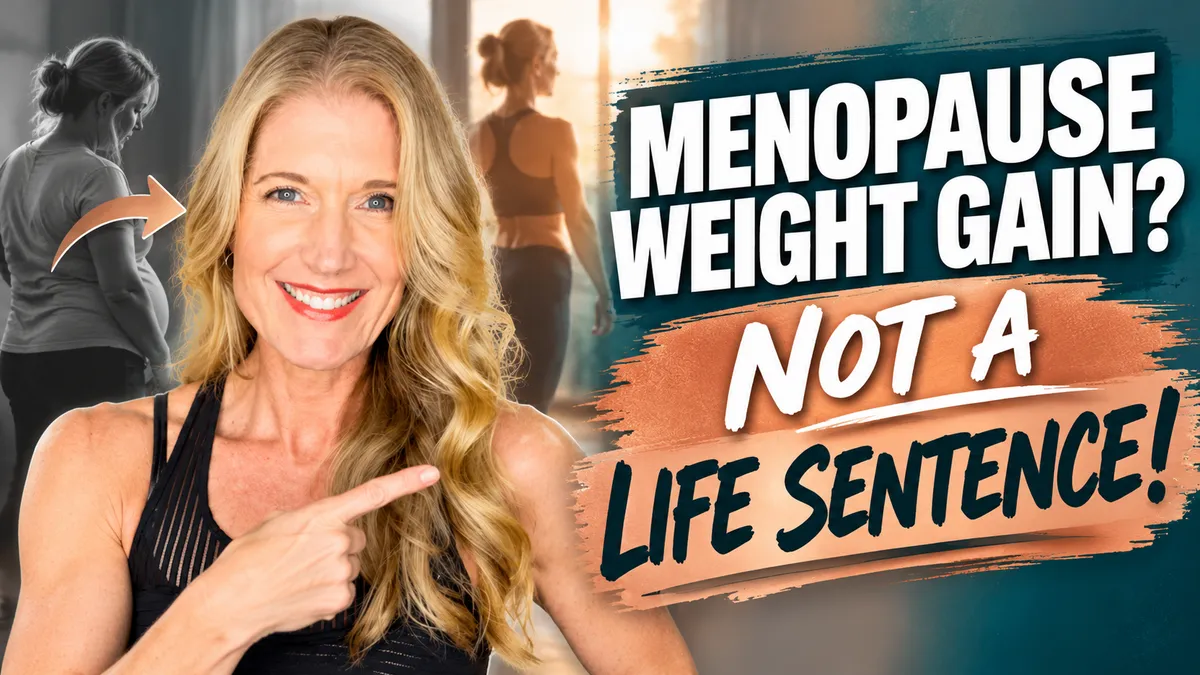
Menopause Weight Gain: Stop Accepting It as Inevitable
Menopause Weight Gain: Stop Accepting It as Inevitable
Your hormones may explain the challenge. They don't get to dictate the outcome.
Somewhere along the way, menopause went from being a normal physiological transition to being treated like a permanent exemption from weight management.
Gained ten pounds? Menopause.
Can't button your favorite jeans? Hormones.
Nothing seems to work anymore? Well, welcome to your fifties.
And apparently, that's where the conversation is supposed to end.
Not so fast.
I'm not interested in dismissing the very real hormonal changes women experience during perimenopause and menopause. I'm equally uninterested in telling women they're powerless against them.
Because those are two very different conversations.
Yes, menopause can change your body. Yes, losing weight in midlife can become more challenging. But somewhere between acknowledging those realities and accepting weight gain as inevitable, we've lost an important distinction:
An explanation is not a life sentence.
And if you've been feeling as though your hormones have taken over the driver's seat, it's time to reconsider who's holding the steering wheel.
Your Hormones Are a Factor. They're Not the Whole Story.
Let's give menopause its due.
Declining estrogen levels are associated with changes in body fat distribution, particularly an increased tendency to accumulate abdominal fat. Sleep disturbances can make appetite regulation and consistent habits more difficult. Meanwhile, age-related changes in muscle mass and daily activity can affect how much energy your body uses.
Those are legitimate physiological considerations, not imaginary excuses.
But here's where we need to be careful.
A contributing factor isn't necessarily the determining factor.
Menopause doesn't suddenly repeal the principles of energy balance. Your body doesn't wake up one morning and decide that losing fat is no longer biologically possible.
What often changes is the environment in which you're trying to lose weight.
Your energy needs may be different. Your sleep may be less predictable. Your previous routine may no longer produce the same results.
That's information you can use.
The problem begins when we take that information and turn it into a verdict: I can't lose weight anymore because of my hormones.
Really? Or have you not yet identified the approach that works for your body today?
Those aren't the same thing.
And women deserve a conversation that recognizes the difference.
Your Old Weight-Loss Strategy May Have Expired
One of the most common things I hear from women in midlife is:
"I used to be able to cut back for a couple of weeks and lose five pounds. Now I do the same thing and nothing happens."
My response?
Then maybe it's time to stop doing the same thing.
We wouldn't expect our professional lives, responsibilities, or priorities to remain unchanged for 25 years. Yet somehow, we expect our bodies to respond to the same weight-loss tactics they did in our thirties.
When they don't, we accuse our hormones of sabotage.
But your body isn't necessarily working against you. Your strategy may simply be outdated.
Perhaps you're moving less during the day than you realize. Perhaps your calorie intake has gradually increased while your energy needs have declined. Or perhaps your efforts have become a cycle of overly restrictive weekdays followed by weekends that undo the intended deficit.
None of these possibilities means you've failed.
They mean it's time to investigate rather than assume.
And here's something else worth questioning: the idea that menopause requires an entirely new collection of weight-loss rules.
Suddenly, women are being sold special diets, hormone-balancing supplements, and metabolic reset programs that supposedly address problems ordinary nutrition can no longer solve.
Menopause has become a very profitable marketing opportunity.
But there is no universally necessary menopause detox, no magic food combination that melts abdominal fat, and no supplement that replaces the fundamentals of sustainable weight management.
A realistic calorie deficit still matters for fat loss. Adequate protein still helps support muscle maintenance. Resistance training remains one of the most valuable investments you can make in your long-term physical health.
The fundamentals haven't become obsolete.
The application may need to evolve.
Stop Giving Your Hormones Credit for Everything
Here's where I want to challenge the conversation a little more directly.
If we attribute every unwanted physical change to menopause, we risk overlooking the things we can actually influence.
You cannot control when your reproductive hormones begin to change.
But you can influence your strength, your eating habits, and how consistently you engage in behaviors that support your goals.
You can evaluate whether your current nutrition matches your current needs.
You can prioritize resistance training instead of relying exclusively on cardio.
And you can stop treating every frustrating weigh-in as proof that your body has become uncooperative.
That doesn't mean every woman has the same resources, health circumstances, or capacity to make changes. Some women face severe symptoms or medical conditions that require professional evaluation and treatment.
But recognizing those barriers shouldn't lead us to overlook the opportunities that remain.
You don't need complete control over your physiology to have meaningful influence over your health.
That's the mindset shift I want women to make.
Because the belief that nothing will work can become its own obstacle.
If you've already decided that weight loss is impossible, why would you bother reassessing your habits? Why invest in strength training if you believe physical decline is unavoidable?
Mindset doesn't magically burn calories.
But it absolutely influences whether you pursue a workable solution or abandon the search.
And that's not a small thing.
More Restriction Isn't Automatically a Better Strategy
There's another trap worth addressing.
When women become frustrated with menopause weight gain, their instinct is often to do more.
More cardio. More restrictions. More attempts to force the scale into submission.
But making a plan harder doesn't necessarily make it more effective.
If you're already struggling with poor sleep, inadequate recovery, or inconsistent eating habits, piling on more exercise and aggressive calorie cuts may make adherence even more difficult.
A better approach starts with an honest assessment of what's actually happening.
Are you consistently eating in a modest calorie deficit, or simply eating very little on some days?
Are you doing enough resistance training to support your muscle mass?
Are you evaluating progress over several weeks rather than reacting to individual weigh-ins?
Those questions are far more useful than asking which menopause supplement you should buy next.
And if you're experiencing significant fatigue, persistent symptoms, or unexplained changes in weight, talk with your healthcare provider. Appropriate medical care and lifestyle changes can work together.
You don't have to choose between addressing your hormones and improving your habits.
You can take your symptoms seriously without surrendering your goals.
The Goal Isn't to Get Your 30-Year-Old Body Back
Let's address another idea that deserves retirement.
Successful weight management in midlife does not require recreating the body you had at 30.
You're not 30.
And that's not a problem that needs fixing.
Your goals can reflect the woman you are now: stronger, healthier, more capable, and comfortable in your body.
That may include losing body fat. It may involve building muscle, improving metabolic health, or maintaining your current weight while becoming physically stronger.
Those are all legitimate goals.
And none requires punishing yourself for aging.
In fact, one of the most important things I encourage women to consider is whether they're pursuing a smaller number on the scale at the expense of muscle, strength, and sustainability.
Because losing weight and improving body composition aren't always the same thing.
The goal isn't simply to weigh less. It's to live better in the body you have today.
A Better Question Than "What Are My Hormones Doing to Me?"
Here's a challenge.
The next time you catch yourself saying, "I can't lose weight because of menopause," change the question.
Ask yourself:
"Given what's changing in my body, what needs to change in my approach?"
That question puts you back in the conversation.
It shifts your attention from an outcome you've already declared inevitable to a strategy you can actually examine.
Maybe you need a more realistic nutrition plan. Maybe strength training needs to become a priority. Maybe you're dealing with symptoms that deserve medical attention before you can consistently follow through.
The answer won't be identical for every woman.
And it shouldn't be.
That's precisely why individualized nutrition coaching can be so valuable during midlife. You're not a generic menopausal metabolism in need of a generic solution.
You're a woman with a specific health history, lifestyle, set of preferences, and goals.
Your strategy should reflect that.
Menopause Isn't the End of Your Options
Menopause can be challenging. It can be frustrating. And for some women, it can make weight management considerably more complicated.
I won't minimize that.
But I also won't endorse the idea that reaching midlife means you should quietly accept unwanted weight gain as your permanent reality.
You may need to change your expectations, refine your approach, and allow more time for progress.
You may also need to redefine what success looks like.
What you don't need is a narrative that tells you your hormones are in charge and you have no meaningful say in what happens next.
Your hormones may explain the challenge. They don't get to dictate the outcome.
You are not at the mercy of your hormones.
You're navigating a changing body—and you still have options.
Ready for a Strategy That Works for the Body You Have Today?
At Wright-Sized Wellness, I help women in midlife develop practical, personalized nutrition and weight-management strategies without extreme diets, unnecessary restrictions, or one-size-fits-all advice.
If what used to work isn't working anymore, let's figure out what makes sense now.
Visit Wright-Sized Wellness or email [email protected] to learn more about personalized coaching.
And I'd love to hear your perspective: Have you ever felt that menopause was being used to explain away changes you still wanted to address? What helped you regain a sense of control?
Do good. Have fun. Be well.
Resources I Know You’ll Love
Tired of feeling unsure of where to find quality supplements?
Many women navigating midlife health concerns—whether it’s energy, metabolism, bone health, or hormonal support—want to use supplements wisely but feel overwhelmed by the options available online.
That’s why I recommend Fullscript, a professional supplement dispensary that gives you access to high-quality, practitioner-grade products from brands that prioritize testing, purity, and transparency.
Instead of guessing which supplements are legitimate, Fullscript allows you to shop from vetted brands in one place, with clear information about ingredients and quality standards.
👉You can explore my Fullscript dispensary here - and don't hesitate to reach out to me at [email protected] if you need additional guidance.