
Weight Loss Shouldn't Be Taking Up This Much Space in Your Head
Weight Loss Shouldn't Be Taking Up This Much Space in Your Head
If you're trying to lose weight, how many times have you already thought about it today?
Before breakfast?
When you got dressed?
When you saw yourself in the mirror?
When someone brought donuts to work?
When you considered whether you “should” exercise?
When you started thinking about dinner before you'd even eaten lunch?
For some women, weight loss isn't just something they're working on.
It's a browser tab that's been open in their brain for years.
And it's exhausting.
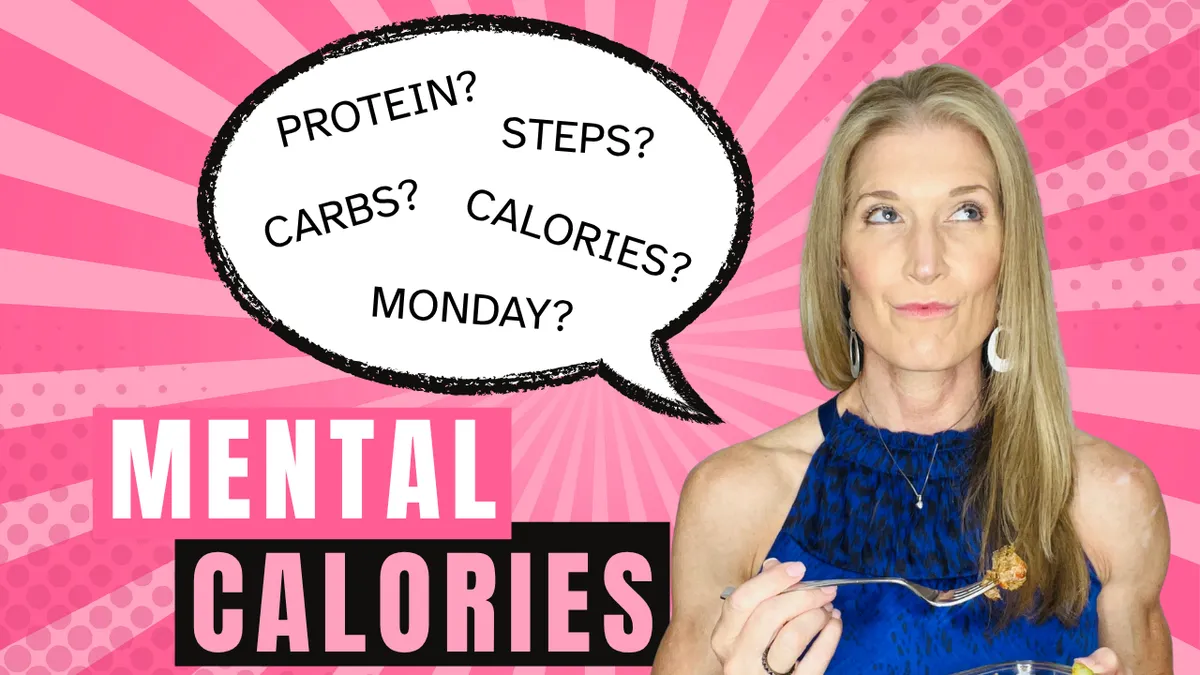
I've started calling all that thinking mental calories—the mental energy we spend researching, planning, worrying, negotiating, second-guessing and feeling frustrated about our weight.
And here's what interests me:
What if one of the goals of sustainable weight loss should be needing to think about weight loss LESS?
When Did Weight Loss Become a Full-Time Job?
There's a version of “healthy living” that requires an incredible amount of management.
Find new recipes.
Calculate everything.
Research the latest supplement.
Figure out the perfect workout.
Watch another video about cortisol.
Wonder whether you should be fasting.
Reconsider carbohydrates.
Start tracking.
Stop tracking.
Buy different groceries.
Read more about menopause.
Start again Monday.
That's a lot of work before we've actually...done much of anything.
And women who are used to being successful in other areas can be particularly vulnerable to this.
We're good at solving problems.
So when weight loss isn't happening, our instinct may be to gather more information, create a better plan and think harder.
But weight loss isn't an exam.
You don't get extra credit for knowing more answers.
At some point, the information has to become behavior.
Your Brain Likes Open Loops
Think about all those little promises you've made yourself:
I need to start walking again.
I should get more protein.
I really need to get serious about my weekends.
I need to figure out my calories.
I should start lifting weights.
None of those is an action.
They're unfinished decisions.
And unfinished decisions have a nasty habit of hanging around.
You haven't decided yes.
You haven't decided no.
So your brain keeps bringing them back to your attention.
Again.
And again.
And again.
No wonder you feel like you're “always working on your weight.”
Mentally, you may be.
Your “shoulds” are exhausting you without changing you.
One of the most freeing things you can do is close some loops.
If you should take a walk, decide when you're walking.
If you should strength train, put the workouts on the calendar.
If you need more protein, decide what you're having at breakfast tomorrow.
Turn a thought into a decision.
Then stop thinking about it.
Make More Decisions Once
This is one of the least glamorous secrets of sustainable weight loss:
You shouldn't have to make every decision every day.
If breakfast requires a committee meeting every morning, simplify breakfast.
If every trip to the gym involves deciding if you're going, give training a regular place in your week.
If Tuesday night always leaves you scrambling for dinner and ordering something you hadn't planned, solve Tuesday once.
This is where routines become incredibly valuable.
Not because routines are exciting.
They're valuable because they remove negotiations.
Instead of asking:
“What do I feel like doing today?”
You've already decided:
“This is what I do.”
That's a much quieter way to live.
Stop Solving Problems You Don't Actually Have
Mental calories also get wasted on minutiae.
Women will spend 30 minutes searching for the “best” high-protein breakfast when they already know three perfectly good ones.
They'll research whether one form of cardio burns slightly more fat than another while averaging 4,000 steps a day.
They'll debate the nutritional superiority of two protein powders while consistently missing their protein target.
That's backwards.
Before you spend another mental calorie optimizing something, ask:
Is this actually the thing keeping me from progressing?
If the answer is no, move on.
Your weight-loss strategy probably doesn't need to be optimized to the fourth decimal place.
It needs to be executed consistently enough to work.
The Goal Isn't to Become Better at Dieting
This is where I think the conversation gets bigger.
If you've spent years trying to lose weight, it's easy to believe success means finally becoming really, really good at managing your weight.
I'd argue that sustainable success looks different.
Eventually, food becomes less dramatic.
Exercise has a place in your life.
A restaurant meal doesn't require a strategy session.
A higher number on the scale doesn't ruin your morning.
You don't need 47 new recipes because you have plenty of meals that already work.
You don't spend Sunday night promising yourself that this Monday will be different.
Your healthy behaviors become ordinary.
That's important.
Because the goal isn't to build a life in which maintaining your results requires constant vigilance.
The goal is to make the behaviors easier to repeat—and easier to stop thinking about.
That's a very different definition of sustainable weight loss.
What Deserves Your Mental Calories?
I'm not suggesting you stop paying attention to your health.
Some things deserve thought.
If your weight hasn't changed for several weeks, look at the data.
If your nutrition isn't supporting your goals, make an adjustment.
If your circumstances change, your strategy may need to change too.
But give a problem the amount of thought it deserves—and then do something with the answer.
Don't spend three days thinking about a 20-minute walk.
Don't spend six weeks researching a strength-training program you haven't started.
Don't spend another Sunday feeling guilty about what you “should” be doing.
Close the loop.
Make the decision.
Take the action.
And then go live the rest of your life.
Because perhaps one of the best signs that you've finally built a sustainable approach to weight loss isn't that you've become better at thinking about it.
It's that you don't have to think about it nearly as much anymore.
This week's Wright-Sized Wellness video, “You're Spending Too Much Energy THINKING About Weight Loss,” introduces my concept of Mental Calories and a simple Mental Calorie Audit to help you see where your weight-loss energy is actually going.
If you're ready to stop making nutrition and weight loss another full-time job and want a strategy designed around your real life, contact me at [email protected].
Do good. Have fun. Be well.
Resources I Know You’ll Love
Tired of feeling unsure of where to find quality supplements?
Many women navigating midlife health concerns—whether it’s energy, metabolism, bone health, or hormonal support—want to use supplements wisely but feel overwhelmed by the options available online.
That’s why I recommend Fullscript, a professional supplement dispensary that gives you access to high-quality, practitioner-grade products from brands that prioritize testing, purity, and transparency.
Instead of guessing which supplements are legitimate, Fullscript allows you to shop from vetted brands in one place, with clear information about ingredients and quality standards.
👉You can explore my Fullscript dispensary here - and don't hesitate to reach out to me at [email protected] if you need additional guidance.